Showing posts with label breach. Show all posts

Wednesday, August 2, 2023

Burger King, Data Breach, French Style

As some of you may be aware of, Burger King experienced another data breach , and it is slightly different from the 2019 event. As before, personal data was exposed due to misconfiguration of their website: specifically in the Jun 2023 incident the passwords for databases and other services were stored in a publicly accessible text file. This would not be that interesting if the incident took place in their US location, where personal data of children was also exposed (Like Panera, which uses palm scanning, Burger King nudged children to enter their info so it was more convenient to order their favourite items and parents to pay without needing to have to go to the cashier), having its customers mysteriously receive emails with blank receipts, or that one of these services whose authentication info was stored in that configuration file was also our old friend Google Analytics would be forgotten in a few weeks.

What makes the special sauce special is this is happened in France, which means it is under the jurisdiction of the GDPR. Data breach investigations under those regulations are rather different than those under US laws. If the American-based multinational cannot prove it has done due diligence regarding how it protects the personal data of its customers and current/future employees, they should at least expect heavy fines: according to GDPR Art. 83(5), severe violations can cost up to 4% of Burger Kings total global revenue, which in 2021 was US$ 1.81 billion. Given the authentication was stored in plain text and children data (which may have been collected in violation of GDPR Art 8, and falls under Recital 38) is at risk, the fast food giant should not expect the French Data Privacy Authority (Commission Nationale de l'Informatique et des Libertés, or CNIL) to be as lenient towards American companies as the Irish one.

This is a very new case -- announced today in the news -- and we have no idea when Burger King reported to the CNIL (per GDPR Art. 33 they must report within 72h of learning of the incident), so we will have to wait to see how it will develop; expect the case to take at least months before the CNIL deliberates and issues fines.

Sunday, April 16, 2023

Passwordless authentication and MFA

There is a push to stop using passwords to authenticate into systems. In 2020 Microsoft announced in its blog that it hopes to make its customers go passwordless in 2021. They plan on achieving it by using FIDO2 security keys such as Yubikey, (smart) phone-based sign-in tools such as the Microsoft and the Google Authenticators, and biometric tools such as fingeprint authentication. They are not alone; Apple and Google have also working on that not only to login to their devices but also websites and apps.

Here is the fun part: those solutions are being pushed as "you only need to pick one of them and you are secure!" Want to login to your phone? Just show your face! Get into your house? Stick your finger at it! How about your bank? Click on something in your phone! So, what it is doing is replacing one form of authentication -- passwords (boo! Hiss!) with a passwordless solution.

What is wrong with this picture?

Does anyone remember Multi Factor Authentication (MFA)? The idea is to use more than one form of authentication so if one is compromised your account is still not compromised. That was usually done by using one authentication from each of the following groups:

  • Something you know. Like a password.
  • Something you have. Like a badge or a Yubikey.
  • Something you are. Like your Iris.
The so-called passwordless solutions being mentioned started their lives as a second factor in the MFA design, but now they are being pushed as the only form of authentication required. That implies those companies do think they are very strong against attacks to be used on their own.

When the FBI and the CISA announced MFA can be hacked, they are really talking about the secondary, passwordless, authentication of the MFA process, password being the primary (which has its own issues, but we are talking here about increasing the odds that the multiple authentications will not all be compromised at the same time). is not a panacea. Like everything else, passwordless authentication can be hacked;see the Uber data breach.

Bottom line

Passwords can be compromised. Passwordless authentication can also be compromised. There is no panacea. Both together should be a bit more secure than each of them. If you are bound not to have passwords at all, get two distinct MFA systems.

As the old say goes, Two is One, One is None.

Friday, March 24, 2023

Github updating its ssh keys

Today I learned that the Microsoft-owned Github decided to update its RSA SSH host host key but did not explain its reasoning. Why would it go through all of this trouble? Usually when a company does that, it is their way to cover that they were hacked or were compromised in some other way. That is not what is written in their blog, so we will have to wait for this to unfold.

"What does that mean to companies and developers depending on that?" Well,

  • If you created a SSH RSA keypair to authenticate against github -- so you can git push and git pull your repos without entering your password -- you probably wants to consider creating a new pair, deleting the old one, and using the new one. Ideally, this may also be an excuse to switch to an ECDSA-derived key such as ed25519 if you are able to. Sometimes this is hard because you may be dealing with a host that does not support that... not that have ever happened to me.
  • If you have received the github RSA pub host key, which was added to your .ssh/known_hosts (if you are using Linux, OSX, and some UNIX variation) file, you will need to delete that entry and get github feed you a new one. Of course, you want to ensure you are getting the proper github key, not one from someone impersonating it.
  • If you use Windows, well, let me get back at you on that later.

Now some developers will argue that relying on known_hosts has caused more failures of working software than preventing faked host access since SSH was originally written. Their proposed way to deal with that is to tell ssh not to check the validity of the host key. In Linux, OSX, and other UNIX versions that would mean to disable that in ~/.ssh/config. If you want to disable the Key checking to all ssh connections, you could do something like (the boldface lines are the most important parameters)

    Host *
           UserKnownHostsFile /dev/null
           StrictHostKeyChecking no
           LogLevel error

While I understand that the above is a clever way of stopping suck pesky keys from hampering your style, disabling security for the sake of convenience is never a good solution. The more time-consuming solution is to remove the offending keys in ~/.ssh/known_hosts so you can ensure you are getting the right key, not a key impersonating the site you want to connect to, which in this case is github.

Fun fact: given that I saw the following message, I think they are not only changing the RSA key:
Warning: the ECDSA host key for 'github.com' differs 
from the key for the IP address '140.82.121.3'

Saturday, December 31, 2022

TransUnion data breaches, GDPR, CCPA, BIPA, and Ramirez

3 round icons representing CCPA, GDPR, and BIPA each of them on their sides implying things are not as they should be

TransUnion LLC, one of the three major credit reporting companies in the United States, also has branches in every continent but Antartica. It is said that just in the U.S. the personal information and credit histories of some 200 million consumers is stored in their servers; I have not been able to find veritable information regarding consumers located outside the US.

Some of you may remember that TransUnion recently suffered a data breach (I will be using the GDPR definition of personal data breach which is "a breach of security leading to the accidental or unlawful destruction, loss, alteration, unauthorised disclosure of, or access to, personal data transmitted, stored or otherwise processed").

"How recently," comes the voice from the back of the room, "which one are you talking about?"

Good question; it is hard to keep track of them. Let's go over a few of them and later see what we can learn from them.

The Events

  1. In 2005 -- a long time ago (in dog years) -- TransUnion lost a laptop containing personal data from more than 3600 US consumers. The Chicago-based company offered up to one year of free credit reports to the affected customers. At the time -- one must remember these were pre GDPR/CCPA/BIPA times -- some of the main questions raised were
    • Were credentials to access the TransUnion databases and other systems also exposed?
    • TransUnion chose to report the data breach. At the time there was no real requirement to do so: the California Senate Bill 1386 of 2002, one of the first security breach notification laws, specified a criteria corporations should use to determine whether they were required to report the incident: if they answered "yes" to every single one of the following questions, they must report the breach:
      1. Does their data include "personal information" as defined by the statute?
      2. Does that "personal information" relate to a California resident?
      3. Was the "personal information" unencrypted?
      4. Was there a "breach of the security" of the data as defined by the statute?
      5. Was the "personal information" acquired, or is reasonably believed to have been acquired, by an unauthorized person?
      The late Alan Paller, director of the SANS Institute at the time, warned this test provided a legal loophole for companies not to report data breaches since all 5 conditions have to be satisfied before a report is required.

    So TransUnion is very popular this month, this time in due to a larger issue than possibly being used to send phishign emails.

  2. During the Summer of 2019, the personal data of some 37000 Canadians being held in TransUnion servers were compromised. Note that the Canadian Digital Privacy Act, which ammended PIPEDA and provided mandatory breach notification requirements, had become law 4 years earlier. Also, GDPR and CCPA had already become law.
  3. On March 12, 2022 ITWeb broke the story of a data breach, which caused TransUnion to admit that attackers had indeed stole 28 million credit records. At first it was believed that more than 3 million South Africans and businesses such as Mazda, Westbank, and Gumtree were affected. The Brazilian group who claims responsibility for this act, "N4ughtysecTU," state it gained access due to a poorly secured (password "Password") TransUnion SFTP server. TransUnion later stated that more than 5 million consumers were actually affected and once again offered a period of free credit reports to the affected customers.

    But Wait! There is more!
  4. On November 7, 2022 it reported to the Massachusetts Attorney General about a data breach that could involve 200 million files profiling nearly every credit-active consumer in the United States. On the same day, TransUnion also sent out data breach letters to all individuals whose information it believes was compromised. As this is still developing, the true impact is yet to be learned.

OK, I will stop here. If they had another data breach between Nov 7 2022 and the time this was published, it should not affect the point of this article.

The Outcomes

According to GDPR Recital 75, a personal data adverse effects to a person (individual) include loss of control over their personal data, limitation of their rights, discrimination, identity theft or fraud, financial loss, unauthorised reversal of pseudonymisation, damage to reputation, and loss of confidentiality of personal data protected by professional secrecy. So, if TranUnion was an European company or people living in the European Economical Area (EEA) were affected by this personal data breach, as the data controller it would have to submit the Personal Data Breach Notification to the Supervisory Authority should be done within 72 hours unless there is no risk to the freedom and rights of a data subject. In this case, they better be reporting. The next step would be to inform all those who were possibly affected about what happened, what are the consequences to their customers, and what TransUnion is doing about it. Of course, those affected should be expected to file complains with their regional Supervisory Authorities (Art 77).

In The United States things are a bit different. U.S. Supreme Court’s 2021 decision in TransUnion LLC v. Ramirez stated that only those that can show concrete harm have standing to seek damages against private defendants. How will victims of a personal data breach prove their personal information was stolen and disclosed by negligence of the company holding this data, and as a result a violation of American consumer protection and privacy laws such as California Consumer Privacy Act (CCPA) and the Illinois Biometric Information Privacy Act (BIPA)? Compare that with GDPR already mentioned article 77 and recital 141, which requires only the data subject (i.e. the victim in this case) considers that his or her rights are infringed or "supervisory authority does not act on a complaint, partially or wholly rejects or dismisses a complaint or does not act where such action is necessary to protect the rights of the data subject."

With that said, it is possible that will change. Given that the US government and the European Union are currently actively working together to establish a new EU-US data flow deal (PrivacyShield 2?), one must wonder how they will balance this Supreme Court decision with GDPR. Which one will have precedence?

Fun Facts

  • I started this article mentioning the phishing campaign they were possibly being used to launch. What if that is related to this data breach? I mean, if your attack has been successful and you are already in the final (Actions on Objective) stage of the cyber kill chain and taking your time to hoover the victim's data, why not see what else you can do while there to pass time?
  • In addition to its main line of business, it also offer services to help companies "protect and restore consumer confidence" after a data breach (they do not list an office address there). In fact, they title themselves as the "One-Stop-Shop Incident Response Solution."
  • I made those round images representing the 3 regulations mentioned here because I did not have an interesting image to put in this article. They turned out nice, so expect me to make more and use them in future posts. You have been warned!

Thursday, December 1, 2022

Phishing Is Too Easy - 5: Season to be Scammed Edition

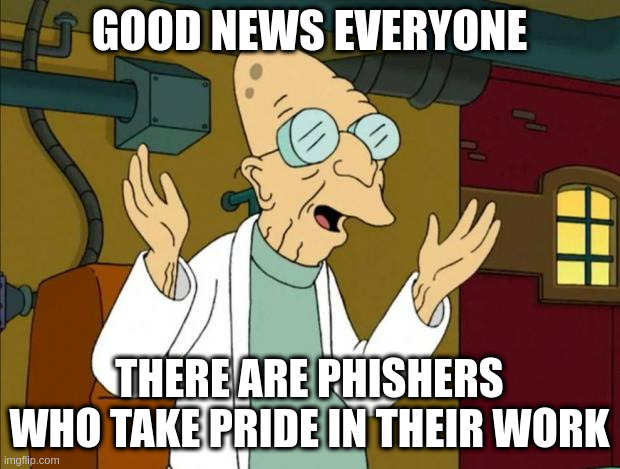
Good news everyone: There are phishers who take pride in their work

We continue our series on phishing emails. I am glad to say a phisher heard my plead and stepped up to the challenge before Black Friday ended!

We have here an email that claims to be coming from American Express which states there is a problem in my card and I need to click on the link to find out. Let's ignore the fact of wether or not I have an American Express card or this article would have ended right here. The timing was good: lot's of people are going crazy purchasing milliong of trinkets online, and then they receive an email saying their card has a problem. Did they go over the limit? Was it's information stolen?

Good show old boy!

If I had such a card, what should I do next? The answer depends on how much effort we want to put in this:

For the impatient

You can't see in the picture but the From: field looks like this:

From: American Express MyCredit Guide <transunion@em-tuci.transunion.com>
Why would TransUnion, a US consumer credit reporting company, be sending emails for American Express? This should be enough for us to immediately drop this email and move on.

For the willing to spend a bit more time

First of all, when in doubt of whether a suspicious email is legit or not, find the official contact number/email of the company in question and reach out to them. In this case, I did call them. American Express said if they send an email, it will contain

  • Your name.
  • The last 4 digits of your card.
This email only contains the first name, so per American Express, it is at best suspicious. They did ask me to forward it to spoof@americanexpress.com, which I did.

For those with time to deep dive and ponder on the implications

Some of you may remember that TransUnion suffered a data breach recently. What if this data is being used to create targeted phishing email? And, what if the criminals are able to either impersonate transunion email addresses or still have access to their servers so they can send emails through their servers? To answer that we need to look in the email header:

ARC-Authentication-Results: i=1; mx.google.com;
       dkim=pass header.i=@em-tuci.transunion.com header.s=scph0919 header.b="ou/BSRUG";
       spf=pass (google.com: domain of msprvs1=19329inrhx0ms=bounces-266758@bounce.em-tuci.transunion.com 
designates 147.253.210.36 as permitted sender) smtp.mailfrom="msprvs1=19329inrhX0MS=bounces-266758@bounce.em-tuci.transunion.com";
       dmarc=pass (p=REJECT sp=REJECT dis=NONE) header.from=em-tuci.transunion.com
Return-Path: <msprvs1=19329inrhX0MS=bounces-266758@bounce.em-tuci.transunion.com%lt
Received: from mta-210-36.sparkpostmail.com (mta-210-36.sparkpostmail.com. [147.253.210.36])
        by mx.google.com with ESMTPS id 62-20020a630141000000b004778207ac4dsi7561754pgb.396.2022.11.26.12.06.50
        for Clueless Sheep
        (version=TLS1_2 cipher=ECDHE-ECDSA-AES128-GCM-SHA256 bits=128/128);
        Sat, 26 Nov 2022 12:06:50 -0800 (PST)
Received-SPF: pass (google.com: domain of msprvs1=19329inrhx0ms=bounces-266758@bounce.em-tuci.transunion.com designates 147.253.210.36 as permitted sender) client-ip=147.253.210.36;
Authentication-Results: mx.google.com;
       dkim=pass header.i=@em-tuci.transunion.com header.s=scph0919 header.b="ou/BSRUG";
       spf=pass (google.com: domain of msprvs1=19329inrhx0ms=bounces-266758@bounce.em-tuci.transunion.com designates 147.253.210.36 as permitted sender) smtp.mailfrom="msprvs1=19329inrhX0MS=bounces-266758@bounce.em-tuci.transunion.com";
       dmarc=pass (p=REJECT sp=REJECT dis=NONE) header.from=em-tuci.transunion.com
X-MSFBL: fXbaPXh+ne/E8ZM3Y6OyFt9TLlavvIujqeENrG6IrbY=|eyJyIjoicmF1YnZvZ2V sQGdtYWlsLmNvbSIsIm1lc3NhZ2VfaWQiOiI2MzgxZGE3MTgyNjM0YmI3ZmY3ZiI sInN1YmFjY291bnRfaWQiOiIwIiwiY3VzdG9tZXJfaWQiOiIyNjY3NTgiLCJ0ZW5 hbnRfaWQiOiJzcGMifQ==
DKIM-Signature: v=1; a=rsa-sha256; c=relaxed/relaxed; d=em-tuci.transunion.com; s=scph0919; t=1669493210; i=@em-tuci.transunion.com; bh=g54YI3MysS1MVd8EV8xjgfkc97E2Z2epcQAJzoXhCkw=; h=To:Message-ID:Date:Content-Type:Subject:From:List-Unsubscribe:
	 From:To:Cc:Subject; b=ou/BSRUG3cUbJKbYUZ1LVr3J0Z3xP7nFJPUjPutaxPAlyQU2bd2vFDbfNHxdU0LbB
	 HxEwc9YzSTrKnrbFfjcLwSxfZk48k6br1t4DI9fsDgWAimdohpxIGKK6ukD2NE1q/L
	 SESZw9WVeXNvoEVjsYIPh67accGucYF32laIH8ICsqeopmxSoaxsrjHBa/MBjqYZAz
	 8r+jHG+Ilr/QzlJ0Lq5rGA/hJGnHR3lPbkuVRFBsrnV9841IbsIpQDVOUdW172sQbQ
	 zZ+JErYKYYvpwmjqd6A4XMPu3TG9QcymMjHHYqcXRmtL4OdKzB8GKtksDI4uLakZkw
	 8HR0NVWvPUjzQ==

At first glance it seems the email came straight from TransUnion, specifically from the host called em-tuci.transunion.com. But, then we find the most interesting entry in the above header exerpt (which I highlited):

Received: from mta-210-36.sparkpostmail.com (mta-210-36.sparkpostmail.com. [147.253.210.36])

It seems this email came from mta-210-36.sparkpostmail.com, whose IP (147.253.210.36) has been whitelisted by bounce.em-tuci.transunion.com as a sender. From there it ends up in the Clueless's gmail account relying on transunion's server's relationship with google's.

But, who is SparkPost?

Short version, it is a mass emailing service. They seem to be well-known enough for Microsoft to have instructions on how to access them using a connector from within Azure. Does that mean they were compromised or the attackers obtained the TransUnion's credentials to use this service?

So, is this Spearphishing via Service (T1566.003)?

If we read the MITRE ATT\&CK® entry, sounds like a very good possibility.

Some kind of Conclusion

Even though this phishing email was much more well thought out than that insult mentioned in the last entry of the series, if you stop and examine it -- without first clicking on its links -- you can still identify it as such rather quickly, without needing to tear down through its raw contents. Don't get me wrong: doing that is fun, but if you are trying to go trhough your daily routine and see this email, in less than 5 minutes you can make a call of whether it is legit or suspicious.

Ok, more if you have to wait on the phone listening to elevator music to talk to a company to verify if they sent said email.

Friday, September 30, 2022

Optus and how to DevOps badly in a few easy steps

Full disclosure: I put Optus on the title because those LinkedIn articles avocate the need for clickbait to attact viewers. Problem is I am actually going to talk about this company. But, this article is really about code development gone bad; Optus just happens to be the perfect example of, in the words of Jeremy Clarkson, what could possibly go wrong.

We are Agile!

In earlier, simpler times, the recommended software development lifecycle model (SDLC for you acronym addicts) was the Waterfall Model. There are many places which describe it better than I could ever do, so suffice to say that it is linear and starts with the idea, then goes to the design, and then a few steps including coding and testing until it is deployed and goes to the maintenance mode. In other words, you start with an idea and then ends up with a product.

Making the code secure, or implementing (Buzzword time!) privacy by design was fairly easy if the security and privacy team was involved fromt he get going, as that was just another well-defined step.

But, what if the product needs to be changed? As in not just a patch but feature request or something that requires a new library or user interface redesign. You need to go back to the start.

You can say it is a bit rigid, and many people agreed with you. Next step was modifying the model so you could hop back one step or two, and that started to get messy. The bottom line is it does not take changes well. In many fields that is completly fine. However, for code which is always changing and put into production as soon as changes are done, like in a website, it can slow down delivering a working product. In some industries, who puts it out first, even if it is not perfect, wins. So, we need something better.

We evolved into the Agile model, which. as a friend taught me, is also called the "Never Finished Model." What the joke implies is that this model is designed to handle changes quickly and deliver a working product even if it is not perfect. The reason is that you can improve on it later once you have some feedback from customers.

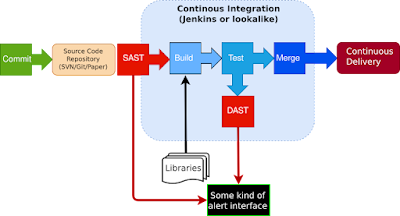
The following picture shows a typical Continuous Integration/Continuous Deployment (CI/CD) pipeline, which is a trademark of using the Agile model in code development. How do we account for security and privacy here? DevSecOps places security controls in the CI/CD process of DevOps. Note the two red boxes: they are the points where we add security testing to the cycle. one is for the Static Application Security Testing (SAST) and Dynamic Application Security Testing (DAST). The red arrows indicate that funny business they find is then send to something which then logs and reports them by creating tickets or sending emails or something else. This is of course, ideally supposed to be done in conjunction with training developers in secure coding, (Buzzword Alert!) pivacy by design, and whatnot.
In reality, some companies/developers which should know better decide that slows them down and hampers their style. In other words, they nee to be putting new code out with new features, and privacy and security are not features but

Enter the Optus

Singtel Optus Pty Limited, a.k.a. Optus is the second largest wireless carrier in Australia. In the last week of September 2022, Optus reported that on 22 September 2022 it was victim of a very sophisticated cyberattack by members of a criminal or state-sponsored organization. This attack resulted in a major personal data breach, where the names, dates of birth, phone numbers, email addresses, street addresses, drivers licences, and passport numbers of both current and former customers was leaked. Optus chief executive Kelly Bayer Rosmarin said that they "are not aware of customers having suffered any harm."

Insert here the videos of a guy in a hoodie in a dark room and computer screens showing random Linux output.

What does this very sophisticated cyberattack have to do with coding?

Glad you asked.

You see, later on it was found Optus had an unauthenticated API, http://api.www.optus.com.au, that released all of the personal data it stored, not only of current but also previous customers (there is the case of someone who has not been an Opus customer for the last 14 years and not only received an email from them about the breach but also started to be flooded with spam). We are talking about data from 10 million people. Unencrypted.

Optus detected the event when the attacker started hitting the AIP hard.

So, the questions are

  1. Why did it have an exposed API without some kind of authentication? Perhaps that was originally done to allow testing of the API more convenient by developers. I myself have seen that in the wild. When developers/DevOps from the environment in question were asked to at least limit access to a network only reacheable from behind their firewall, they shrugged it off saying the VPN (which is not a solution but sure is an improvement) was too cumbersome to use from their personal laptops.
  2. Why was the connection to said exposed API unencrypted? Do you remember when we said that DevSecOps places security controls in the CI/CD process? That probably would have caught that: the SAST would have noticed the unencrypted connections in the code; the ones I have used before would bark at unencrypted traffic (and hardcoded passwords, which was not the case here since no passwords were used). In the real world that does not happen as much as people believe. In fact, it is too common to hear that devsecops slows down the of devops' work.
  3. Why was the personal data stored unencrypted? Once again, convenience. Maybe when that was recommended, it was then turned down because developers argued it would slow the response time of the system. Once again, SAST would have caught that.

Clearly there were poor security practices at play here. Perhaps DevOps security and privacy training never happened, or SAST/DAST was never implemented in the SDLC chain. Usually that happens because they are considered cost centers in business that, as mentioned earlier, slow down progress. Remember we mentioned that automated security testing will create tickets developers will have to deal with in addition to the other tickets they already have on their plates.

Post Morten

Don't be that guy!

  • Privacy by design would not have allowed this kind of code to even make into the repo.
  • Encrypt the traffic to the API, period. Ideally that should be done at the API level. I know some people will put a Nginx proxy in front of the unencrypted API (using kubernetes or docker), and I cringe about that: it is an improvement from the Optus setup but not by much.
  • Encrypt your data at rest. Yes, that is specially important for personal data, but it is a good habit regardless.
  • All connections to an API should be authenticated by default. If you have a query, say list status, you want to make available unauthorized to users, spend some serious time thinking on the consequences.
  • Ensure your CI/CD process has proper security controls. If DevOps is being swamped with the tickets generated by these controls, this may either mean they need more security and private training, or the controls need better tuning, or the external code/libraries you rely on are not as well written as they should. That is how BadUSB and many of the IoT issues came into being.


Thursday, December 16, 2021

Apache Log4j and IoT

Yes, this is yet another blog article on the vulnerability in the Apache Log4j Java-based logging framework, which was first disclosed (CVE-2021-44228) in Dec 9, 2021. Many brave souls spent their weekend patching their servers and other computers to version 2.15.0. And then, a new vulnerability was found in its replacement (CVE-2021-45046), which requires an upgrade to 2.16.0.

And then 2.16.0 did not solve CVE-2021-45105 so we are now (Dec 19) on 2.17.0.

There are right now many great articles by brilliant people on how the attack takes place, what you can do to detect whether your (Apple, Linux, Windows) systems are affected, and how to prevent it. Therefore, this article will do the unthinkable and instead focus on the security and privacy impact on Internet of Things (IoT) devices.

The Problem

According to IoT Analytics, the global number of IoT devices should be around 12.3 billion. That is a lot of coffee machines, fridges, Nest thermostats and cameras, Amazon Ring, smart televisions, insulin pumps, and talking toasters. And some of them are voice operated thanks to Alexa, Cortana, and Siri. How many of them have their firmware/OS updated once deployed? Is that trigger by the user, run on a schedule in the device, or pushed from the mothership to the appliance? How many of them can have their firmware/OS updated to begin with? And, so we can keep this on topic, how many of them use log4j?

Even without this new vulnerability, IoT devices are not known for their initial security settings or capability to be upgraded to remain secure. Nest is actually one of the better ones, but attacks to it have been documented, including simply hacking into the users' accounts to identify the patterns and find the best times to rob their houses (ideally when you are away for a few hours).

Some claim the strong point of most of the IoT devices is they are connected using WiFi, as if that makes it more secure than being connected using ethernet or fibre. In other words such a device "is completely a wireless device that has a low tendency for vulnerabilities." That assumes the wireless network is impervious to attacks; the reality is not the case. First it does not require the attacker to be physically in the location; just being in the parking lot suffices. Second, it gives the upper edge for patient criminals. Finally, someone can break into the website used to manage these devices and push some malicious payload which can help scan the target network/traffic in search of vulnerable devices. The log4j one is but another vulnerability in their arsenal.

Privacy Impact

The kill chain here is business as usual:

  • Get a foothold through an IoT device
  • Upload shellcode and/or packages to this device
  • Use device to can the network to learn the way of the land and to locate more potential targets.
  • Rinse and repeat until finding useful data, be that in the form of files and passwords or just enabling microphones and cameras.

The attacker who is there just for the joy of breaking in will then post captured pictures and videos, and send messages back to the IoT device owners as shown in the previous video. The more malicious attacker will harvest as much personal data -- account info for other services, medical info, videos and sound recordings -- as possible that not only compromises the current victim but also future ones known by current target.

"So, where's the privacy impact?" you may rightfully ask. When our criminal friend successfully exploited the vulnerability, he committed a security breach. Now, when he then stole medical records, credit card info, account information, and even monitored the house in the last paragraph, he commited a privacy breach; and that is where the money is.

Let's revisit the video I linked earlier. The Merriam-Webster dictionary defines privacy the quality or state of being apart from company or observation. That attacker can view and listen to everything that family does in their home, so per definition this family's privacy is compromised.

Let's now look at it from a business standpoint: the fines imposed by GDPR for exposing personal data from a person (GDPR calls that a Natural Person) is up to 20 million Euros or 4% of the annual global revenue (table stolen from a previous article). I am not saying it will be always that much, but the data protection authority will not be pleased if this was due to devices that were designed so they cannot be updated.

But don't take my word for it. We already mentioned how serious the GDPR is about data breaches. It is now alone; the NIST is also concerned about the IoT security, and created a program to help governments, industry, academia, and consumers become aware of the issue and minimize its impact.

Useful resources

Wednesday, November 17, 2021

German Federal Office for Information Security leaks private encryption key

BSI office in Bonn. Photo by Oliver Berg, DPA

The Bundesamt für Sicherheit in der Informationstechnik (German Federal Office for Information Security) (BSI) is the German federal agency in charge of managing computer and communication security -- critical infrastructure protection, internet security, certification of security products -- for the German government. It also advises manufacturers, distributors, and users on identifying and minimizing data security risks. Like many organizations, when the GDI needs to send or receive an encrypted email, it relies on the OpenPGP standard. It creates a public/private keypair and then shares the public key with anyone who wants to send a message. That not only allows senders to know only BSI can decrypt their messages but also verify it was indeed BSI who replied to it.

Early this month Golem.de reported that the BSI, when asked for the public key by someone who wanted to submit confidential information, accidentally sent the corresponding private key. Eventually this key was revoked and a new keypair was issued, but that happened only after Golem.de contacted the BSI.

Questions

  • How long has the BSI known of that data breach? Per GDPR's Article 33, a data breach should be reported to the nearest Data Protection Authority within 72 hours of the Data Controller, in this case the BSI, becoming aware of it.
  • How long did it take for its Data Privacy Officer (DPO) to inform the data subjects? Per the Golem.de article, the BSI kept using this key pair for months after the incident.
  • How many data subjects were affected by this data breach?
  • Has it immediately created a new keypair and let all those who rely on that know of the incident and receive the new public key? According to the Golem.de article, the BSI still used that keypair for months after the incident.
  • The BSI stated the key was password protected. One must assume the (accidental) recipient of this email had the password. However, we have no idea of the strength of password. Because of how the SMTP protocol works, there are many opportunities to get a copy of the email containing the encrypted key as attachment. And then, it becomes the classic password cracking routing in the comfort of your home.

Notes

While many are looking at this event from a security standpoint, this really should be seen from the privacy standpoint:

  • The impact on the privacy of those who have used this compromised key is yet to be understood. How much personal data has been exchanged using this very key under the assumption it was protected from prying eyes? This encryption key is probably only used to transmit sensitive data; once it is received, it is downloaded, extracted, decoded, and then acted upon. So, unless it is deleted, it is stored in encrypted format at the customer's and the BSI destination mail accounts. And it is possible that the mail transfer agents (MTA) that act as hops between them, storing and relying to the next hop, also keep a copy for a period of time.
  • While they probably did a Data Protection Impact Assessment (DPIA), one must assume this kind of data breach was not a possibility they considered. However, hindsight is always 20/20: it very easy to, after this breach is exposed, point fingers at them, but I would like to know any company which accounted for this in their risks from their accidental or unauthorized actions list before this incident.
  • Privacy by design is a lofty goal, but in reality it can never be fully achieved. Best we can do is take this as a teaching moment. For instance, we expect that the BSI will now implement a system in which private keys can be used but not directly accessed.

References