Showing posts with label cryptography. Show all posts

Saturday, September 17, 2022

There and back again: DEFCON 30

Second slide in the workshop reminds the audience we had put instructions on github for what to do before attending the event.

No, I did not postpone posting about my trip to DEFCON30 until now because I did not have anything to post this month. The truth is I was slacking. There, I said it.

This will be a bit of a post morten of our workshop. Will this post have any useful info? Don't hold your breath; what I can promise is there will be many opportunities to laugh at our expense.

The Plan

For those who read the announcement for our workshop at the Crypto and Privacy Village, you know that there are two authors -- Matt and yours truly -- who put together the mess without killing each other; the fact we had half a continent between us probably helped.

Originally, the plan was to start with an explanation of why this phone privacy thing was so important and then get show how to do it. Ideally people would have read the announcement, followed our instructions, and show up with a phone ready to be configured. While one of us would be on the podium, the other would then be helping the audience.

After we had the entire workshop done and did a few dry runs, we started thinking: how many people will bring a phone that meets the requirements? Probably not many -- not many people have spare phones that can take CalyxOS or LineageOS in their kitchen drawer -- and we will not be able to bring enough loaners as all the resources in the workshop are coming out of our own pockets. We could just shrug it off and tell people "Hey you did not bring a phone, so we will bore you with screenshots."

Thing is, we had taken a lot of screenshots of everything we would be showing in the phone, in case we would not be able to share the phone screen or point a camera at it. So, this was an option but we felt that would detract from the workshop; instead of being something interactive it would be no better than watching a video.

We needed a plan B.

What if we provided an emulator? It will not do everything a real phone can but it will allow the audience to follow along on their laptops. Since we were going to focus on CalyxOS (we had only an hour to run the entire workshop; compromises had to be made), we then decided to create that image, make it available somewhere, and then update the wiki with instructions on how to use it. We also asked the Crypto and Privacy Village (CPV) people to add a single line in the workshop announcement, indicated with a green line in the picture below, to tell people they should install Android Studio in their laptop.
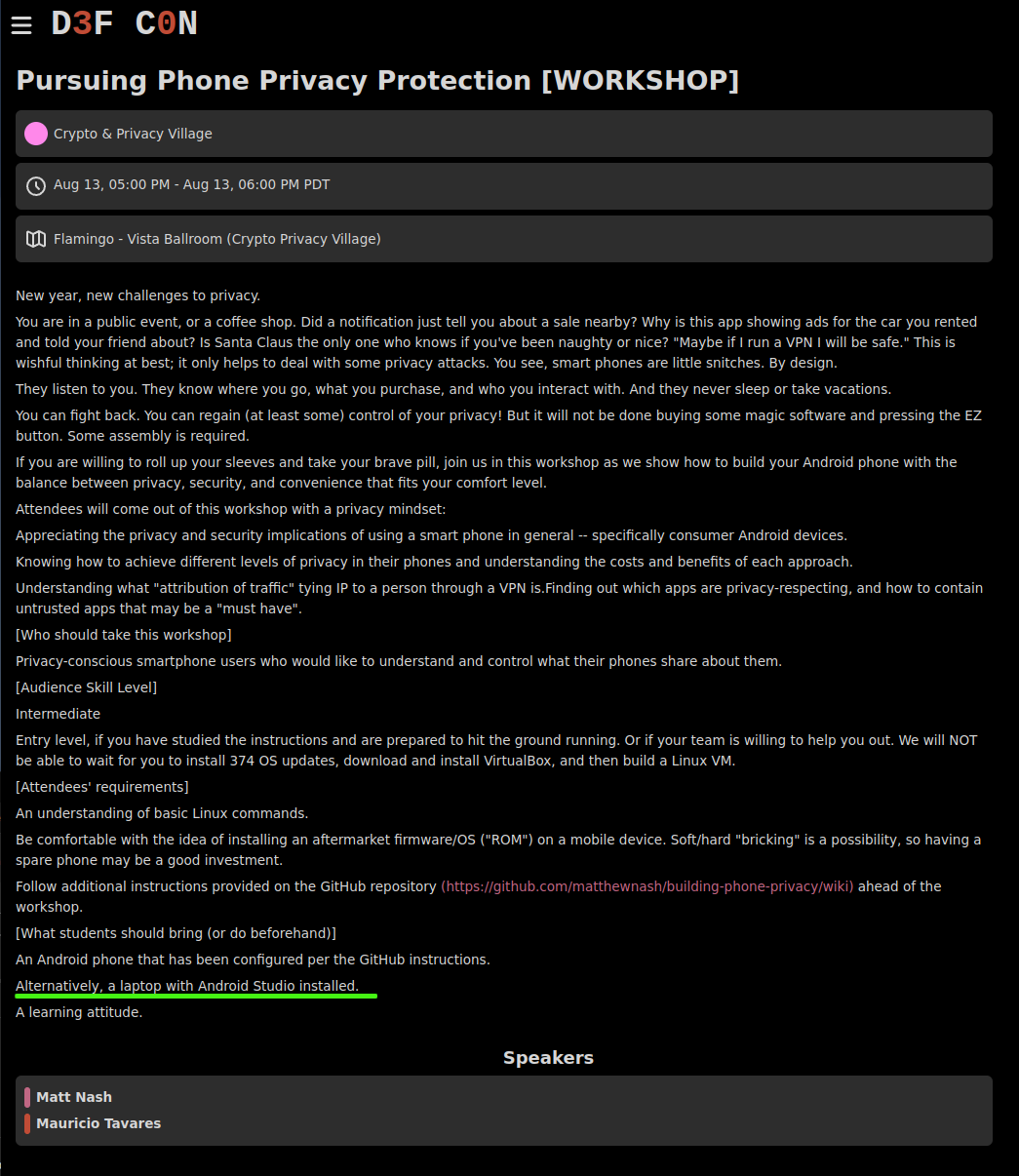
Wrokshop announcement, with the line 'Alternatively, a laptop with Android Studio installed' added to it, indicating you may want to install it if you do not have a phone to use in the hands-on bit

The plan was to have everything finished two weeks before the event and then take the last week to practice, and ensure we had a reliable way to hand out the emulator images.

Things did not happen according to the plan.

Matt was able to go to DEFCON from the beginning of the event; I do not know if he also was able to stop by BSidesLV. I, on the other hand, was a bit more time constrained: I flew the first flight on Friday and was going to return on Saturday after the workshop. In any case, we were going to try to attend as many events and talks as possible, and meet up with people we have not seen in ages. I also planned on volunteer to the CPV.

What really happened?

  1. Building the CalyxOS phone image was not as smooth as we hope for. In plain English, I could not make it work. I had no issues building LineageOS ones in my docker build environment -- if someone reminds me I can post instructions on how to do that later -- but CalyxOS was fighting me all the way. Fortunately we were working in parallel and Matt was able to make it work.

    I will let Matt post how to create the CalyxOS image with all the apps already installed in his blog, as he is the one that made it work. In fact, it worked so well, he used that instead of a real phone during the hands-on part of the workshop.

  2. We spent too much time trying to come up with a clever way to deploy the phone image. After days of frustration we came up with a simpler way to do that, wrote the docs that worked whether you had a Linux, Mac, or Windows laptop, and put it with the image.
  3. The emulator stopped working. I do not know why but it went on strike. More frustration ensued. Was it the emulator itself or the image? Once again Matt rose to the occasion and made it work.
  4. We also found out it would take too long to download the image we built using the DEFCON public network. Fortunately we had a bunch of USB drives and decided to put in each, formatted in some Windows file system so all 3 OS could mount them, the image and instructions.

There are probably more things that went wrong, but I cannot think of them right now. Bottom line is we spent most of the time that week working on these bugs. And, we made it work.

Showtime

The CPV people did a great job. Everything was working smoothly on their side. I did most of the overview and then Matt took over for the technical part:

Matt Nash presenting the hands-on part of the workshop. Audience is spaced out following the social distancing requirements

You will note on the above picture the audience (picture was taken from the back out of respect) has set some chairs apart for social distancing's sake. I then came back from the podium sporting one of my favourite shirts (bonus points if you recognize it) with the final comments and we then took questions. After it ended, Matt was surrounded on the podium with members of the audience for a long while until the Defcon Goons kicked us out.

Mauricio Tavares on the podium spreading lies and misinformation while sporting the classic Oregon Trail shirt.

Thank you for all the fish

  • Avi Zajac and the rest of the Crypto and Privacy Village crew for not only having us there but making the event possible. And the badge. And the shirt (I am afraid of wearing it out because it is nice). And keeping the Goons at bay. And the sticker!
  • The NCC Group for mentioning us in its August announcement.
  • DEFCON for, well, being defcon. I do with I had more time to see it all this year instead of being in a hotel room trying to get all working. But, it was all worth in the end.
  • CalyxOS for trying to make a more secure and private Android distro easier to install. There is more around this line item, but I am getting ahead of myself.

Sunday, July 31, 2022

Phone Privacy at DEFCON 30!

So our workshop on smart (I will keep a straight face here, just saying) phone privacy was accepted by the Crypto and Privacy village at DEFCON 30. If you are there, we will be presenting it on Saturday Aug 13th. As it will be only one hour, we strongly recommend to first to folow the instructions in the co-author's github-based wiki; this link is also in the official DEFCON accouncement, but it is so important we would rather mention it a few times.

So, what is it all about?

Short version: how to make your smart phone more private and why you should care. I could elaborate on that, but this post is not about the contents of the workshop: go watch it and find out!

Anything useful you want to tell us?

People have told me I have some kind of fixation with bullet points; let's not disappoint them, shall we?

  • No pictures will be taken with my phone; I will be bringing a camera -- ancient but trusty Canon ELF -- to take some pictures of the event. Yes, compared to modern smart phones its resolution is pathetic. But, it has a real zoom, using real lenses, has no understanding of wireless file transfer (great during DEFCON), and does not keep you up at night when vendor stopped creating patches for it. As this will be a real camera, not smart phone, they will not be posted in real time.
  • I was comparing our abstract with the other presenters' and realized ours is gigantic by comparison! This is not a size competition, and I realized it may e nd up being a bit of a turnoff. But, there is some logic behind the madness: we really wanted to make sure people knew what to expect and that they need to prep are for the workshop. Which leads to...
  • The "talk" part of this workshop will be rather short because the main dish is the hands-on part.
  • If you to get your hands dirty, bring an Android phone. It's two main requirements are
    • A phone you are fine if it is bricked. That can happen. And, you can find out if it does brick before attending the event because we put the setup instructions in the wiki.
    • Ideally, you want to have a phone such as Google Pixel (3 and above), OnePlus, or Fairphone. Main reason is because a lot of Android phones have a closed source "blob" of code that is only updated for a brief period of time (a year? A week?), until not longer after replacement hit the shelves. However, we are not saying "for best experience you should have bought the latest $1000 phone" (bonus point if you know where I took that from). We do think everyone should be able to strive for a private focused phone (sounds like a tag line for a product, eh?). In fact, we will have a Pixel 4 to show things, but a Pixel 3 will work just fine and can be found for around $50 if you look hard enough. When I checked this morning, an used Pixel 4 was hoving around $100.
    • FYI, I have issues with the Google Pixel phones, primarily how hard it is to repair it.
  • I would love if we could make the phone fully private from a GDPR (we tend to mention it a lot in this blog?) standpoint, but that won't happen. Compounding that, some countries do not take your efforts to protect your privacy in your phone very kindly.
  • I really would like to thank the Crypto and Privacy village for having us. This may sound the typical fake message you associate with Facebook and LinkedIn, but for a change it is real. One of the hints is that I am not starting this thread with "I am excited that;" the truth is that we have been working hard and long hours on this and the CPV crowd have put up with all of our stupid questions and rewrites and whatnots. And have not tried to strangle us!

Dude, I have an iPhone! What should I do?

Dude, I have no clue; I do not have an iPhone to research on!

Thursday, February 24, 2022

Thoughts on taking the CISSP exam - 2

Plan Your Dive, Dive By Your Plan

That is the motto of the Divers Alert Network, and I think it is very appropriate here... and on job interviews.

One thing I did not add to the original post on taking the CISSP exam is that on the day before the exam, I drove to it about the same time I expected to leave. Reason is that I wanted to know where the place was and how long it would take so I would be there 30min or so before it started. In other words, I wanted to eliminate a source of pre-test stress.

Without further ado, here are the real pictures I took that day:

  1. First, here is the building. After driving there on the day before, I decided to leave home 15 minutes earlier to account for the traffic I saw. Also, I am glad I did the dry run since on the exam day, when I drove into the road that leads to the parking lot the building is located, it was packed. I then realized by looking at the vehicles they were going to the construction site I noticed in the previous day, so I was able to go around them instead of sitting there and missing my appointment.

    If you are not driving there, it is even more important to figure out how to get to the test site well in advance. Imagine if you need to take a few trains and maybe a subway or a tram in the process? Are they schedule reliable? If you miss one of those public transports, how long will you have to wait until the next?

  2. Once inside, I was very happy to find out there was a nice sign pointing to where the Pearson VUE office was. Nice touch, Pearson VUE!
  3. The actually office where the exam took place was down the corridor. I also took the opportunity to find out where the bathroom is. Remember you can take bathroom breaks; it might be wise to find its location so you do not waste valuable exam time hunting for it when you really need to go.

    Incidentally, there was a water fountain across the corridor from the bathroom.

  4. During exam day, I had no problem getting there ahead of time. In fact, I was so ahead of time the suit was still locked. By then a few more candidates, for other exams it turned out, had showed up. We chatted a bit until they let us in. And it was smooth sailing until the exam started.

TL;DR: Make your life easier! Eliminate as many variables before the exam as you can.

Saturday, January 8, 2022

Thoughts on taking the CISSP exam

There are a lot of sites, articles, and videos with lots of useful and helpful information on how to prepare for the CISSP exam, including why you should (or not) consider getting this certification to begin with.

This is not one of them.

Everyone has a study strategy -- watching videos, reading books, taking a live/online class -- so I will not comment on that. What I did after is where I want to focus on, namely taking practice exams. Short version is learn from my mistakes. Long version is that there are

  • Known knowns: what you already know from your experience and previous study.
  • Known unknowns: what you know that may be in the exam but you have never studied or dealt with. For many, that would be binary math and cryptography.
  • Unknown unknowns: what may be in the exam and you have no idea it even exists to begin with.

What you know, you know so no need to spend much time on that besides refreshing. What you know you do not know, you can study/practice/figure some way to learn. But, if you do not know that you do not know something that may be in the exam, it will bite you. You need to convert the unknown unknowns into known unknowns so you can work with them. To find them, focus on those practice tests at least for the last two weeks before the exam. You are using these exams to probe were you need to work on. Examine the results and explanations associated with the questions you did get wrong. In my case, they could be grouped as:

  1. Rushing to read and missing a keyword. Read the entire question and all the answers. I know that sometimes the question starts with 5 sentences of story time before getting to the point, but take your time to read it all. Then read it again to identify the key points in both question and answers. Slow is fast, fast is slow. But, there is too slow; don't be James May.
  2. Choosing an answer, second guessing, and then finding out the original answer was right. This is specially true for those questions you are not really 100% sure of the answer, and was how I missed most of the practice questions by far. Train and trust your gut.
  3. Not eliminating the answers you know for sure are not right. As mentioned above, you will face questions that you are not sure of the right answer for some reason, like some encryption detail, but you may be able to deduce it. To do that, remember a Sherlock Holmes quote, "once you eliminate the impossible, whatever remains, no matter how improbable, must be the truth." First thing you need to do then is get rid of all the answers that could not possibly be true. Sometimes that will leave you with two answers, which means you have increased your chances of getting the right answer from 1 in 4 to 1 in 2 (it might be even better depening on how you want to calculate it).
    NOTE: this may not work with questions you need to select 4+ answers from a list. In one of the practice questions I took, it turned out I needed to select all of them. I read the explanation, try to understand the thought process, and then add to my study notes.
  4. Trying to solve it as an engineer instead of as manager. This is reference to the famous "think as a manager" quote associated with this exam. Technical me may want to write my own solution while managerial me would refer to policy, buy a tool, or contract someone. If both technical and managerial questions are listed, pick the later for this exam.
  5. (last but not least) you may be missing some knowledge. When I find those, I look at the explanation, add what I think will help me to my notes, and then check for futher info (in a book or online).

Full Disclosure: Items 1-4 were where I needed to work on.

Sunday, August 8, 2021

Is your phone plotting against you?

There is say that states when cats nap, they dream of plots to kill their "owners."

What about phones?

Ok, maybe phones are not planning on killing you, and should have grown out of their arsonistic phase, but that does not stop them from being up to no good. You see, they are always sending information about your location, what you are saying (Alexa and Siri, I am looking at both of you), what you have searched for or bought, and even pictures and videos (think taking a protored exam at home, but creepier). Bottom line is smart phones are little snitches: they compromise your privacy by design.

There are things that can be done to minimize the impact of this intentional data exfiltration both in a behavioral and technological level; that was the topic of the workshop "Practically Protecting Phone Privacy" we presented earlier today at the DEFCON 29's Crypto and Privacy village. I was going to write about it after we were finished, but after 4h of almost nonstop -- we just took 10min breaks every hour -- I was braindead. Understand I was up since 5pm checking and rechecking the slidedeck, the timing, and the demo. The latter did not happen because of network connectivity issues (we were doing this remote). Good thing we planned for that and had a set of screen captures -- phone, Android tools, etc -- to show the different steps. That does not make me happy since I bought 2 phones specifically for that part of the workshop, but, as one of the slides in our presentation says, we need to get out of our comfort zone.

We created a github repo to put the docs and links associated with this talk. It started as instructions to set phones up before the workshop but we plan on adding more stuff. As a result, it is a work in progress (the nicer term is living document).

Right now I still feel braindead (as my typos demonstrate) so it will take a while until I add something clever to this thread. Still, at least I would like to thank the folks at Crypto and Privacy village for having us and putting up with our troubles and shenanigans.