That is the motto of the Divers Alert Network, and I think it is very appropriate here... and on job interviews.
One thing I did not add to the original post on taking the CISSP exam is that on the day before the exam, I drove to it about the same time I expected to leave. Reason is that I wanted to know where the place was and how long it would take so I would be there 30min or so before it started. In other words, I wanted to eliminate a source of pre-test stress.
Without further ado, here are the real pictures I took that day:
First, here is the building. After driving there on the day before, I decided to leave home 15 minutes earlier to account for the traffic I saw. Also, I am glad I did the dry run since on the exam day, when I drove into the road that leads to the parking lot the building is located, it was packed. I then realized by looking at the vehicles they were going to the construction site I noticed in the previous day, so I was able to go around them instead of sitting there and missing my appointment.
If you are not driving there, it is even more important to figure out how to get to the test site well in advance. Imagine if you need to take a few trains and maybe a subway or a tram in the process? Are they schedule reliable? If you miss one of those public transports, how long will you have to wait until the next?
Once inside, I was very happy to find out there was a nice sign pointing to where the Pearson VUE office was. Nice touch, Pearson VUE!
The actually office where the exam took place was down the corridor. I also took the opportunity to find out where the bathroom is. Remember you can take bathroom breaks; it might be wise to find its location so you do not waste valuable exam time hunting for it when you really need to go.
Incidentally, there was a water fountain across the corridor from the bathroom.
During exam day, I had no problem getting there ahead of time. In fact, I was so ahead of time the suit was still locked. By then a few more candidates, for other exams it turned out, had showed up. We chatted a bit until they let us in. And it was smooth sailing until the exam started.
TL;DR: Make your life easier! Eliminate as many variables before the exam as you can.
If you grew up in The United States, you may recognize the picture below and remember television ads (yes, I have watched network television with commercials) that would push some trinket (think on the lines of a "belt that doubles as straw" or "self-cleaning shoe rack" which in fact is really complicated). When it came the time in the ad to say how much it was and how to order it, there was always a "But wait! There is more!" segment where they would bundle more junk in hopes the viewers would think they are getting a deal.
We mentioned them before, so let's just focus on the most important ones:
Stop using Google Analytics; it violates GDPR Article 44. Google Ireland does not cut it.
If you really need the functionality provided by Google Analytics, find a tool that transfer data outside the EU.
Any data collected by a Google Analytics-like but GDPR-friendly program should either be immediately anonymized (before being fed to the analytics program), has a Legitimate Purpose as defined in GDPR Article 6, or requires explicit consent from the data subject.
According to the CNIL ruling, the French website in question has 1 month to comply.
Given that NYOB filed complaints the 27 European Union Member States and the three other states belonging to the European Economic Area (EEA), expect more of these decsions to come.
By now you may have learned that if you are an European company, or a company which does business with European residents, you really should not be using Google Analytics. Case in point happened in Oct 2nd 2020 when, according to The Register, the Austrian Data Protection Authority (Datenschutzbehörde or DSB) received a NOYB-sponsored complaint regarding NetDoktor, a website which offers medical knowledge and health information. It also has versions of this website in English (TLD ".uk") and Danish (TLD ".dk") languages; there may be more but I could not be bothered to look for them. Because this Hubert Burda Media-owned website is financed through advertising and licensing, it chose to Google Analytics probably (educated guess here!) to track what each of its users have done during their visit:
Identifiers
IP address
Browser version, operating system, and other system identifying parameters
Which pages were read
How much time was spent on each page
Per the General Data Protection Regulation (GDPR), this kind of personal data collection is not viewed as a Legitimate Purpose as defined in Article 6, so it needs to have explicit permission from the data subject. One should also notice that because of the service provided by this website, the personal data collected using Google Analytics, unless properly anonymized, may be used to infer the medical condition -- which is one of the special categories of personal data per GDPR -- of the data subject.
It gets better:
Google is an American company, so it must follow the US CLOUD Act of 2018 and section 702 of the FISA Amendments Act of 2008, which allows US intelligence agencies to collect any personal data stored in servers owned by US businesses that are identified as "electronic communication service provider" by 50 U.S. Code § 1881(b)(4) without the need of a warrant.
Google cannot protect the personal data being collected by Google Analytics in the NetDoktor website to satisfy the Article 44 (transfer of data to be processed on a country outside the European Union or European Economic Area).
Google cannot base the data transfer on standard data protection clauses as the US does not ensure adequate protection
And that means this personal data transfer between NetDoktor and Google violates the Schrems II decision of 2020, where the European Court of Justice (ECJ)declared the Privacy Shield mechanism was not a valid means of transfer data between EU/EEA and the US.
As a result, the DSB declared this data transfer illegal.
Some EU and US companies may have tried to work around these limitations by using Standard Contractual Clauses to transfer data between them. That does not satisfy Schrems II.
What can I do as a US business?
The ideal solution is for the US to adopt privacy laws that are closer to those in the EU. Until that happens,
What if I run a website that is not offering a product or a service specifically directed to an EU or EEA resident, like a blog? Even though technically you would not be subject to Article 3 of GDPR, you have no reason to collect any personal data. Let's use Blogger, which is owned by Google, as an example. According to google's documentation, to use analytics with blogger you must
Sign up for an analytics account
Add analytics tracking to blogger.
Continuing with the Blogger theme, is Google honoring your decision not to collect data? i.e. does it collect any other additional data from the blog users it has not divulged to the blog owner? Good question; IMHO the onus here would be with Google.
What if I am providing services/products targeted at EU/EEA residents? You fall into Article 3, so
Minimize the amount of personal data you have to collect. Remember you are still subject to the CLOUD Act.
Avoid using cookies or other form of analytics to collect data you do not need to provide the service to your customers. Remember the Legitimate Purpose (Article 6).
If you really need the functionality provided by Google Analytics, find a tool that transfer data outside the EU.
Anonymize any data you can as soon as possible. Rememeber anonymization is not tokenization or pseudo-anonymization.
Process and store any personal data in an EU server, ideally one not owned by an American company identified as "electronic communication service provider" by 50 U.S. Code § 1881(b)(4).
In that often misunderstood time between mullets and the switch to laptops without normal USB ports (I am looking at you, Apple), a traditional part of an on-premises pentesting was to grab all those USB drives you got from those many conferences you attended, wipe them to remove the informercials, white papers, and and other cruft, put a little script that would be called when the drive was automounted in a Windows or Mac (primarily Windows because it was easier), and then drop them on the parking lot of the company you are doing your engagement on.
The script was pretty simple: when run it would collect the IP, some computer info, and username. And then it would send that info to a collecting site (cannot call it C&C because it is not doing that much work), which would then parse all the info in a nice spreadsheet which you would then bring to your meeting with your customer as the list of users that may need some security retraining. After all, if a pentester can do that, so can a malicious attacker (are there non-malicious attackers?). It is a nice way to deploy a virus, or a program to help the attacker to get a foothold in the system.
Those were simpler times.
Talks were given and dongles were created to avert such an attack because, well, it was easier to buy them than asking IT department to push a group policy to disable automount. Or telling users not to mount any USB device they find on their computers.
But, we are talking about BadUSB! Yes, and it was first mentioned in 2014. The short version is that thanks to the typical development methodologies similar to those used in IoT development, namely get a product out there as quickly and cheaply as possiblw with complete disregard to supply chain security or security testing in general, a lot of USB devices are built on controllers which can be reprogrammed in the field. And reprogrammed they are, this time carrying malicious payloads like programs to spy on the user or get a foothold on the system.
Sounds familiar? I think so. Adding your code to the USB device's hardware to it is but an evolution of the principle of having code in a USB drive that is run when it automounts.
There is no one-size-fits-all technical solution for BadUSB, not that have stopped vendors peddling software to address it. We will go over detailed a plan of action to minimize the effectiveness in a future article, but it sufices to say the old adage of "select your partners and wear protection" still applies. Also, end users are one of the most important lines of defense in the security domain. Work with them, empower them to understand and make the call; it can work if you do it right. Make the presentation enjoyable and memorable. I mean, if I could make that work at a medical institution to the point our box of found USB drives had to be replaced with a bucket, so can you.
Platform independent. While most of my work is done in Linux, I like to have the same experience in OSX, Windows, and even (somewhat) smart phones. This is also important when i recommend a browser to someone.
not spying on me. Problem is, most of them do, but that is a topic for another article.
Good privacy and security settings.
I am not particularly religious about browsers; I have used Firefox, Chrome, Safari, That Microsoft One, Brave, Opera, and a few others I can't remember the name (short of the screen capture and the crowdcity link, I am trying to type this in one sitting). I think each of them have good and bad features. Let me talk about my favourite feature in Safari; to do so I need a screen capture:
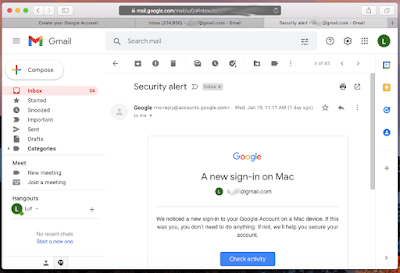
It shows the browser in incognito/secure/secret/sneaky/something mode (pick your term, collect them all). It has 3 tabs right now. The 2nd and the 3rd tabs are connected to two distinct gmail accounts: one with a ton of emails (someone needs to do some cleaning) and one which is not as popular as the first. The third one was me helping someone create a gmail account but I decided to take the screenshot before going any further. Note there are possible 3 gmail sessions using 3 different accounts in 3 different tabs in the same browser. Take your time to process that.
I will wait.
FYI, I normally would use that with slack: at time I have 5 to 6 open slack sessions -- maybe work, vendor, project I am working on (like the conference mentioned in an earlier article), and so on -- using different accounts. Or two different AWS accounts (think developer and test user). And all of that in the same browser at the same time. And they are all happy.
Now, I use Firefox a lot because it is portable and it (and its derived browsers) can be rather privacy-conscious:
There are many features it has, but this kind of tab separation it does not. They have something called containers which (1) only work in normal (not incognito mode) and (2) do not offer the feature Safari does. So this leads into...
And now my shameless request
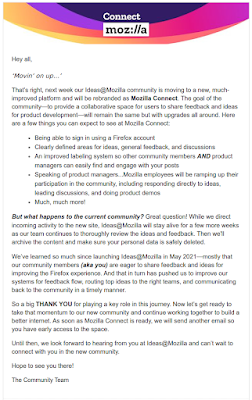
The Mozilla people has a website where you can ask for features. People post them and they get voted on by viewers like you, thank you. Guess what I requested? Right you are: tabs that are fully isolated so you can run the same program logged in as different users without conflict. If you want to help make this happen, do create an account and vote for it. The link to my request is
There are a lot of sites, articles, and videos with lots of useful and helpful information on how to prepare for the CISSP exam, including why you should (or not) consider getting this certification to begin with.
This is not one of them.
Everyone has a study strategy -- watching videos, reading books, taking a live/online class -- so I will not comment on that. What I did after is where I want to focus on, namely taking practice exams. Short version is learn from my mistakes. Long version is that there are
Known knowns: what you already know from your experience and previous study.
Known unknowns: what you know that may be in the exam but you have never studied or dealt with. For many, that would be binary math and cryptography.
Unknown unknowns: what may be in the exam and you have no idea it even exists to begin with.
What you know, you know so no need to spend much time on that besides refreshing. What you know you do not know, you can study/practice/figure some way to learn. But, if you do not know that you do not know something that may be in the exam, it will bite you. You need to convert the unknown unknowns into known unknowns so you can work with them. To find them, focus on those practice tests at least for the last two weeks before the exam. You are using these exams to probe were you need to work on. Examine the results and explanations associated with the questions you did get wrong. In my case, they could be grouped as:
Rushing to read and missing a keyword. Read the entire question and all the answers. I know that sometimes the question starts with 5 sentences of story time before getting to the point, but take your time to read it all. Then read it again to identify the key points in both question and answers. Slow is fast, fast is slow. But, there is too slow; don't be James May.
Choosing an answer, second guessing, and then finding out the original answer was right. This is specially true for those questions you are not really 100% sure of the answer, and was how I missed most of the practice questions by far. Train and trust your gut.
Not eliminating the answers you know for sure are not right. As mentioned above, you will face questions that you are not sure of the right answer for some reason, like some encryption detail, but you may be able to deduce it. To do that, remember a Sherlock Holmes quote, "once you eliminate the impossible, whatever remains, no matter how improbable, must be the truth." First thing you need to do then is get rid of all the answers that could not possibly be true. Sometimes that will leave you with two answers, which means you have increased your chances of getting the right answer from 1 in 4 to 1 in 2 (it might be even better depening on how you want to calculate it).
NOTE: this may not work with questions you need to select 4+ answers from a list. In one of the practice questions I took, it turned out I needed to select all of them. I read the explanation, try to understand the thought process, and then add to my study notes.
Trying to solve it as an engineer instead of as manager. This is reference to the famous "think as a manager" quote associated with this exam. Technical me may want to write my own solution while managerial me would refer to policy, buy a tool, or contract someone. If both technical and managerial questions are listed, pick the later for this exam.
(last but not least) you may be missing some knowledge. When I find those, I look at the explanation, add what I think will help me to my notes, and then check for futher info (in a book or online).
Full Disclosure: Items 1-4 were where I needed to work on.
Yes, this is yet another blog article on the vulnerability in the Apache Log4j Java-based logging framework, which was first disclosed (CVE-2021-44228) in Dec 9, 2021. Many brave souls spent their weekend patching their servers and other computers to version 2.15.0. And then, a new vulnerability was found in its replacement (CVE-2021-45046), which requires an upgrade to 2.16.0.
And then 2.16.0 did not solve CVE-2021-45105 so we are now (Dec 19) on 2.17.0.
There are right now many great articles by brilliant people on how the attack takes place, what you can do to detect whether your (Apple, Linux, Windows) systems are affected, and how to prevent it. Therefore, this article will do the unthinkable and instead focus on the security and privacy impact on Internet of Things (IoT) devices.
The Problem
According to IoT Analytics, the global number of IoT devices should be around 12.3 billion. That is a lot of coffee machines, fridges, Nest thermostats and cameras, Amazon Ring, smart televisions, insulin pumps, and talking toasters. And some of them are voice operated thanks to Alexa, Cortana, and Siri. How many of them have their firmware/OS updated once deployed? Is that trigger by the user, run on a schedule in the device, or pushed from the mothership to the appliance? How many of them can have their firmware/OS updated to begin with? And, so we can keep this on topic, how many of them use log4j?
Even without this new vulnerability, IoT devices are not known for their initial security settings or capability to be upgraded to remain secure. Nest is actually one of the better ones, but attacks to it have been documented, including simply hacking into the users' accounts to identify the patterns and find the best times to rob their houses (ideally when you are away for a few hours).
Some claim the strong point of most of the IoT devices is they are connected using WiFi, as if that makes it more secure than being connected using ethernet or fibre. In other words such a device "is completely a wireless device that has a low tendency for vulnerabilities." That assumes the wireless network is impervious to attacks; the reality is not the case. First it does not require the attacker to be physically in the location; just being in the parking lot suffices. Second, it gives the upper edge for patient criminals. Finally, someone can break into the website used to manage these devices and push some malicious payload which can help scan the target network/traffic in search of vulnerable devices. The log4j one is but another vulnerability in their arsenal.
Privacy Impact
The kill chain here is business as usual:
Get a foothold through an IoT device
Upload shellcode and/or packages to this device
Use device to can the network to learn the way of the land and to locate more potential targets.
Rinse and repeat until finding useful data, be that in the form of files and passwords or just enabling microphones and cameras.
The attacker who is there just for the joy of breaking in will then post captured pictures and videos, and send messages back to the IoT device owners as shown in the previous video. The more malicious attacker will harvest as much personal data -- account info for other services, medical info, videos and sound recordings -- as possible that not only compromises the current victim but also future ones known by current target.
"So, where's the privacy impact?" you may rightfully ask. When our criminal friend successfully exploited the vulnerability, he committed a security breach. Now, when he then stole medical records, credit card info, account information, and even monitored the house in the last paragraph, he commited a privacy breach; and that is where the money is.
Let's revisit the video I linked earlier. The Merriam-Webster dictionary defines privacy the quality or state of being apart from company or observation. That attacker can view and listen to everything that family does in their home, so per definition this family's privacy is compromised.
Let's now look at it from a business standpoint: the fines imposed by GDPR for exposing personal data from a person (GDPR calls that a Natural Person) is up to 20 million Euros or 4% of the annual global revenue (table stolen from a previous article). I am not saying it will be always that much, but the data protection authority will not be pleased if this was due to devices that were designed so they cannot be updated.
But don't take my word for it. We already mentioned how serious the GDPR is about data breaches. It is now alone; the NIST is also concerned about the IoT security, and created a program to help governments, industry, academia, and consumers become aware of the issue and minimize its impact.